


EUDR is no longer just a compliance issue. It is an executive liability issue.
Connect Big4‑based and validated EUDR intelligence into your existing systems with transaction-level methodology built for defensible decisions.
Most EUDR Systems Manage Processes.
They Do Not Justify
Decisions.
They collect documentation and structure inputs, but lack a
consistent, transaction-level basis for explaining why a
shipment was approved. With the Environmental Crime Directive,
environmental violations can become criminal offences across the
EU.
The requirement is no longer process — it is
defensibility.
What Changes in 2026, Two Timelines Collide.
The Environmental
Crime Directive
enters national criminal law on 21 May 2026 across EU Member
States, with country-specific implementation. Environmental
violations, including breaches linked to EUDR obligations,
can be treated as criminal offences, with potential
penalties including imprisonment of up to five years.
Responsibility
extends beyond operational compliance to legal and executive
leadership, increasing scrutiny on how decisions are made
and documented.
Directive (EU) 2024/1203 available on
EUR-Lex.
EUDR Enforcement Follows in 30.12.2026
requiring companies to demonstrate compliance at the level of individual transactions. It is no longer sufficient to maintain documentation — organisations must be able to show, for each shipment, what requirements were applied, what information was used, and why the decision was made. This creates a direct need for consistent, traceable, and audit-ready decision logic across all transactions.
2026 requires companies to justify compliance at the level of individual transactions.
What Kohtas Actually Does
Kohtas is not another EUDR platform. It is a Big4-based regulatory intelligence layer that sits inside your existing systems and connects compliance directly to each transaction.
For every shipment, Kohtas provides the applicable regulatory logic based on product and origin, defines the required document structure, and applies consistent risk and mitigation logic. The result is a unified decision framework that produces audit-ready outputs for every transaction.
SEE FULL EUDR APIThe EUDR Decision Infrastructure for Executives
Integrate Big4-validated regulatory logic into your existing ERP and due diligence systems to ensure every transaction is supported by a consistent, defensible decision framework. Built for CFO, CEO, and Chief Legal oversight where auditability, liability, and financial exposure converge.

Enterprise Resource Planning (ERP)
SAP, Oracle, Dynamics 365, Sage, Infor, Workday etc.
Embed EUDR decision logic directly into your core
financial and operational workflows. Each purchase order
is evaluated against applicable regulatory requirements by
product and origin, ensuring completeness of documentation
and consistency of approval decisions. This reduces manual
intervention while aligning compliance with financial
control and reporting.

EUDR Due Diligence Software
Your own developed solution, Satelligence, Osapiens, Koltiva, IOV42, Optel Group...Extend your existing due diligence systems with externally validated legal logic and transaction-level risk assessment. Kohtas provides jurisdiction-specific requirements, mitigation logic, and document validation based on Big4 data and methodologies, enabling consistent, defensible outcomes across all suppliers and shipments. This ensures that internal processes can withstand external scrutiny from regulators, auditors, and counterparties.

Kohtas EUDR Legality API
Independent, Big4-validated regulatory intelligence for transaction-level decisions.Provide a single, authoritative layer for EUDR decision-making. For each transaction, the API delivers applicable legal requirements, required documentation structures, and risk assessments grounded in Big4-validated data and methodologies. It validates documents in real time, links them to specific shipments, and produces audit-ready outputs that explain why a decision was made. This creates a defensible position across finance, legal, executive accountability, and liability.
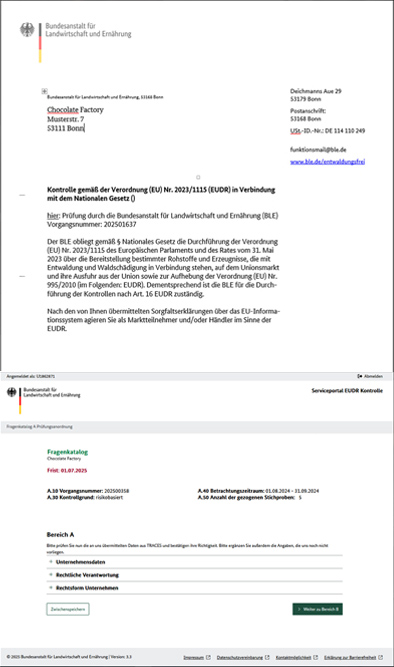
Example: German BLE Audit Process under EUDR
-
1
Transaction-Level Verification
The German Federal Office for Agriculture and Food (BLE) performs EUDR checks on the basis of individual transactions. Each shipment connected to a Due Diligence Statement (DDS) can be selected for inspection, meaning that compliance is tested exactly at the transaction level required by the regulation.
-
2
Audit Notification by Email
When a transaction is chosen, BLE sends an official audit request by email to the operator. The message contains a secure link to the BLE online audit portal, where the company must upload all required supporting documentation (geolocation data, land-use rights, supplier contracts, invoices, etc.).
-
3
72-Hour Deadline and Consequences
Companies have a maximum of 72 hours to provide the requested documents. Missing the deadline, or providing incomplete information, may lead to the shipment being held at customs or blocked entirely from entering the EU market. This makes rapid access to reliable compliance data and risk assessments essential.
Open BLE slides here.. -
4
Future Criminal Liability Risks
In addition to financial penalties and operational disruptions, companies must prepare for the new Environmental Criminal Law Directive (Directive (EU) 2024/1203). By 21 May 2026, all Member States must transpose it into national law. Under this directive, violations of the EUDR prohibition in Article 3 may be punishable with imprisonment of up to five years, significantly raising the stakes for senior executives and compliance officers.
For full text and legal details, refer to Directive (EU) 2024/1203 of 11 April 2024 on the protection of the environment through criminal law, available on EUR-Lex.
EUDR has moved from compliance to executive liability.
Listen to the Kohtas EUDR podcast episode for executives.
If EUDR is still being treated as a software project in your organization, you are likely looking at it too narrowly.
Book an executive briefing to see how transaction-level EUDR methodology can support legal defensibility, enterprise controls, and board-level risk management.